|
|
Materials |
pine tree, cowhide
|
Size
|
2 ja (66cm) x
2 ja /2.5 ja (83cm) x 2.5 ja/3
ja (99cm) x3 ja |
Our product, Dae-buk,
is superior in its magnificent
and beautiful appearance. Since
it is made from red pine trees
dried during the winter season,
its intensity is excellent.
Drum¡¯s intensity is important
in that its rim is struck with
drumstick as a part of playing
skills. With its outstanding
intensity, drums made by Hanwulrim
are greatly loved by professional
drum players. In addition, we
use only the first-class thick
hides of oxen raised in Korea
as materials for drum and employ
the technique to coat drum frame
with glass fiber sheets. With
these specialties of Hanwulrim,
we can resonate the elegant
sound of Hanwulrim¡¯s drums
throughout the
world. |
|
¢Â Modeum-buk
(Drum consist of diverse kinds of small
drums) ¢Â |
|
Materials |
pine tree, ox-hide
|
Size
|
1.3 ja (43cm)
/ 5 chi (15cm)/ 8chi (24cm)
x 2ja (66cm) |
Modeum-buk made
by Hanwulrim is famous among
professional players for its
strong frame and excellent sound
resonance, which is only possible
with the thick ox-hide. Like
Dae-buk, it is made from red
pine trees regarded as having
good quality that helps to increase
the intensity of the drum and
have beautiful patterns. Drums
with diverse size are possible.
Each different sound from the
different size drums beautifully
harmonizes. We manufacture the
special rapport of drum music
in accordance with different
performing situations. All of
these are the main parts of
which Hanwulrim is most proud.
|
|
¢Â Oi-buk (single
drum) ¢Â |
|
Materials |
pine tree, ox-hide
|
Size
|
174 cm x 60 cm
|
The drum is manufactured
with prefabricating method.
Since it is made of the strong
red pine tree, it can keep its
shape for a long time even with
violent playing for a long time.
The sounds produced from the
first class hides resonate even
in people¡¯s mind. In order
to prevent any change, high
quality tree of lauan is used.
The drum becomes the representative
high quality instrument. In
addition, the exquisite beauty
of the painting adds the outside
beauty of drums. Nobody would
hesitate to recommend the drum
as the partner of great performance. |
|
¢Â Changgo (the
traditional Korean hourglass-shaped drum) ¢Â
|
|
Size
|
55 ~ 62cm (long)
|
Materials |
Trunk made of
paulownia wood, cowhide (or
hide of dog, ram or horse),
leather loop to control strings
|
Features |
coating with waterproof
substances inside of the trunk,
excellent durability and antibiosis |
With its hourglass
shape, it is also called ¡°Se-yo-go¡±
which means slim-waisted drum.
The trunk is mainly made of
paulownia or sometimes of metal
or other trees. The left side
called ¡®Gungpyun¡¯ is covered
with cowhide, while the right
side called ¡®Chaepyun¡¯ with
horse or ram skin. The trunk
is made of paulownia wood. In
accordance with the thick of
leather, the sound is different.
For example, if leather is thick,
it produces low tones. On the
other hand, if the leather is
thin, it produces clearer and
higher sounds. The part called
¡®Gulrae¡¯ is moved left and
right to control sound higher
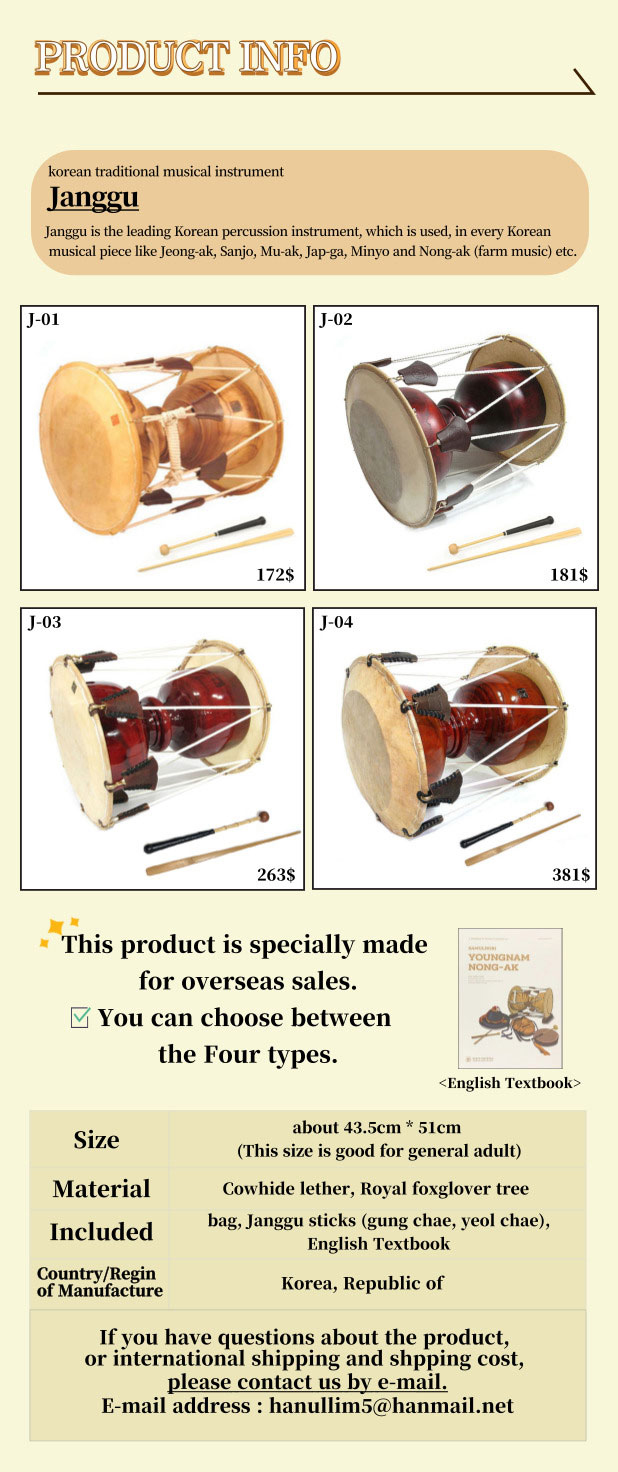
or lower. In short, Changgo
is the leading Korean percussion
instrument, which is used, in
every Korean musical piece like
Jeong-ak, Sanjo, Mu-ak, Jap-ga,
Minyo and Nong-ak (farm music)
etc. |
|
¢Â Samul-buk (drum
for Samulnori) ¢Â |
|
size |
diameter 35~45cm
|
Materials
|
paulownia wood
and cowhide |
Features |
Covering each
sides of the trunk made of paulownia
wood with cowhide and then fastened
with strings weaving the holes
of each cowhide¡¯ rim |
Drum is one of
the most primitive musical instruments
to human beings. In the beginning,
buk or drum itself was an independent
instrument, but as other instruments
developed and vocal music came
into being, the drum became
more important in accompaniment
rather than an independent performance.
But, in many countries, drum
itself has remained as a good
single performance instrument.
In Korea, drum along with Changgo
(the traditional Korean hourglass-shaped
drum) is the excellent independent
performance instrument in drum
dance and nong-ak (farm music).
In the past, drum¡¯s trunk was
made of wood trunk whose inside
was carved out. Nowadays, the
trunk is made of several wood
boards. Both sides of the trunk
are covered with cowhide. Various
kinds of hide were used in other
countries. In Korea, hide of
cow or dog had mostly used.
There are 20 kinds of drum in
Korea, among which 10 kinds
of drums are rarely used at
present. Drums have different
names according to shapes. The
size of drum used for Nong-ak
is 45x25cm. The inside part
of paulownia log cut through
and covered with cowhide, then
fastened with strings which
are tightened by inserting wedges
under them. With these wedges,
tone of sound can be adjusted.
Contrary to Samul-buk, the drum
for p¡¯ansori (traditional Korean
opera) is wrapped with a piece
of hide once and then put with
same another hide to each drumhead,
having them fixed with tiny
metal tacks embedded around
the rim of both drumheads. So,
drum for p¡¯ansori can not control
tones of the sound.
|
|
¢Â P¡¯ansori Buk
(drum for p'ansori) ¢Â |
|
Size
|
diameter 38cm
|
Material
|
Trunk made of
paulownia tree, cowhide |
Features |
The drum is used
in p'ansori as an accompaniment.
The two sides of trunk are covered
with cowhide which are fixed
with round-shaped nails. |
It is also called
¡®Sori-buk¡¯ and usually used
in p¡¯ansori (narrative folk
song) as an accompaniment. A
player of this drum is called
¡®Gosu¡¯. You can know the important
role of ¡®Gosu¡¯ in the Korean
sayings; ¡°one Gosu equals two
great singers¡±. ¡®Gosu¡¯ also
adds amusement by saying encouraging
words (called ¡®Chuyimsae¡¯)
in the course of singer¡¯s narration
and song. Contrary to ¡®Pungmul-buk¡¯
(drum used for Pungmul-nori)
of which sides are tied up with
string, Sori-buk¡¯s trunk is
itself used for playing music
and cowhide wraps each side
of the trunk being fixed with
iron buttons.
|
|
¢Â Jing (Taegum:
big gong) ¢Â |
|
Size
|
diameter 39cm
|
Material
|
brass |
Features |
Hammering repeatedly
brass into shape (this kind
of method is called ¡®Bangjja¡¯),
So, having excellence in sound,
sound resonance and spreading.
|
It has not been
exactly known when the instrument
was first used, however, -a music book produced
during the reign of King Sungjong
of Chosun Dynasty mentions about
Taegum and Sogum and the instrument
was called ¡®Jing¡¯ or ¡®Taegum¡¯
according to its usage. For
example, in Chongmyo-jeryeak,
the 11 minor keys that are known
as Chongdaeop are played when
three cups of Korean liquor
are presented to the spirits.
Chongmyo is the shrine where
the spirits of the Kings in
Chosun dynasty are honored and
the instrumental and vocal music
with dance used in the ceremony
is called Chongmyo-jeryeak.
When the first cup of liquor
is presented, it is announced
with beating the instrument
called ¡®Jwago¡¯ (the large
size drum on the prop) ten times.
When the third cup of liquor¡¯s
presentation is over, beat ¡®Taegum¡¯
ten times in order to announce
the end of music. In nong-ak
(farm music), k¡¯kwaenggari
plays small and fast rhythm
while Jing plays the each first
major key of rhythms. Jing is
played with a drumstick wrapped
in cloth. In the past, rice
straw instead of cloth once
were used to make sound more
soft. It is a tendency that
drumstick is getting harder.
|
|
¢Â
K'waenggari (Sogum) ¢Â |
|
|
|
Size |
22cm diameter
|
Material
|
brass |
Features |
repeatedly hammering
brass into shape, which is the
same type of percussion as Jing,
but only, much smaller. It is
not easily broken and has clear
and elegant sound. |
It is also called
K¡¯waenggari or Sogum. Like
jing, it is also made of brass
but smaller than jing. This
instrument¡¯s name is varied
in accordance with its usage.
For example, it is recorded
as Sogum when it is used in
Chogmyo-jeryeak and k¡¯waenggari
in Nong-ak (farm music). In
Chongmyo-jeryeak, Sogum is played
three times after Jingo and
Taegum were played at the first
key. In Nong-ak (farmer¡¯s music),the
two person who play k¡¯waenggari
are named as a Sangshoi (a first
gong-player) and Bushoi(a second
gong-player). The former plays
the role of conductor and uses
more high-tone sounds of gong
and the latter more soft and
low-tone sound of gong. K'waenggari
played in Nong-ak has the handle
with red silk-thread and play
with mallet made of wood. In
order to prevent rupture of
the gong, it is beat with mallet
slightly side of it. Attaching
or taking off hands to the back
of the instrument can produce
various sounds.
|
|
|
|
|
Materials
|
Paulownia wood
and cowhide |
Features
|
It is played as
an accompaniment and famous
for its beautiful ¡®Dancheong¡¯-various
colors-. |
This is an instrument
made of a frame and a suspending
drum. It had not been seen in
the old literature until the
painting of Kim, Hong-do (a
genre painter of late of the
Chosun Dynasty). His painting
shows well the formation of
six Korean traditional music
instruments expressed as ¡®Sam-hyun
Yuk-gak¡¯ [Sam-hyun: Komungo
(a 6-stringed zither), Kayagum,
and Dangbipa, Yuk-gak: Buk (drum),
Changgo (traditional Korean
hourglass-shaped drum), Haegeum,
Taegum and a pair of Piri].
Jwago is played together when
the left side of drumhead of
Changgo is beaten at the first
or strong key of rhythm. The
instrument is also played as
an accompaniment in dance or
in the woodwind instruments
ensemble and the concert of
wind and string instruments,
etc. |
|
|